ChatGPT Ads are live in Malaysia. We tried them so you don’t have to.
ChatGPT Ads landed in Malaysia less than two weeks ago, and of course we couldn’t resist poking at it. Here’s how it works, how it feels next to Google, Meta and TikTok, and whether it deserves a slice of your budget yet.
· 7 min read
People don’t just Google it any more

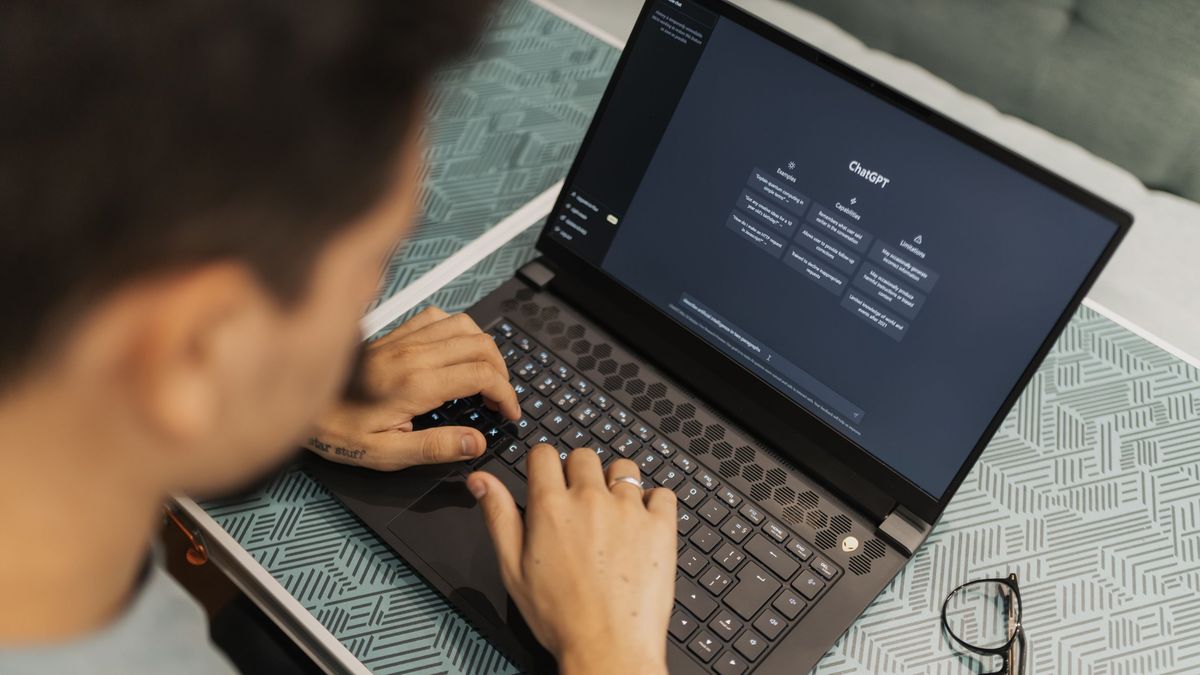
Be honest: the last time you planned a Penang trip or compared two laptops, at least part of it happened in ChatGPT, typed as a full question with your budget and every fussy requirement, rather than three keywords in Google, and you’re definitely not the only one. OpenAI says ChatGPT now has 1.2 billion weekly users, and ChatGPT Ads is built for exactly that moment, when people are weighing up their options.
Google isn’t going anywhere, and it’s still where plenty of leads come from. What’s changing is that discovery is spreading out, so a customer might spot you on Instagram, ask ChatGPT for a shortlist and only then Google your name before they call. Brands that only plan for that last step will keep missing more of the journey.
It’s not just about ranking on Google any more. It’s whether you come up when someone asks ChatGPT.
What landed, and how it works
OpenAI announced on 23 September that ChatGPT Ads was coming to Malaysia and six other Asian markets, taking it past 60 countries. Ads only show to people aged 18 and above on the Free and Go plans, sit below ChatGPT’s answer with a “Sponsored” label, and stay away from conversations about health, mental health and politics. OpenAI is also very clear that ads don’t change what ChatGPT says, and that advertisers never see anyone’s chats.
- What you pay for
- Views (per 1,000 impressions), clicks, or conversions tracked through OpenAI’s pixel or a GA4 connection.
- Who you reach
- Country, device and platform, custom audiences of at least 25,000 matched users, and a short description of your business that OpenAI calls a context hint.
- The ad itself
- A title, one line of copy, an image and a landing page, and that’s all.
- What you see after
- Impressions, clicks, spend and conversions, split by device, country and platform.
Setting it up: one sentence and a leap of faith
Launching is quick, and the ad is about as simple as ads get: an image, a title and one line of copy. Here’s ours, fresh out of Ads Manager.
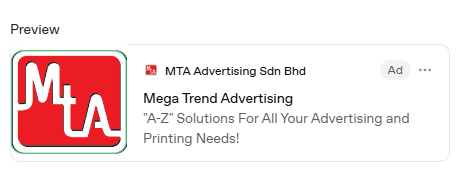
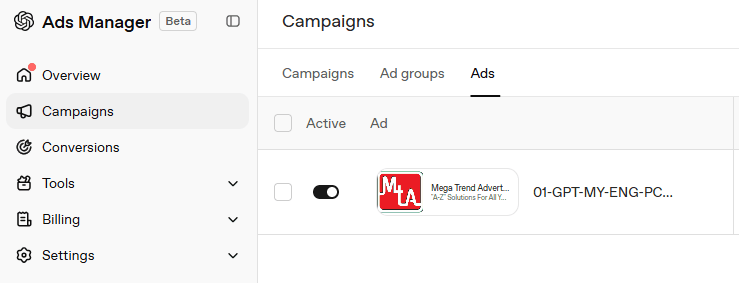
Then you reach targeting and realise that, apart from country and device, your main lever is a sentence describing your business. There’s no negative keyword list, no placement list and no age, gender or interest targeting. OpenAI’s own guide says context hints are “not targeting rules or delivery instructions”, which is a nice way of saying ChatGPT decides.
Reporting is where it gets properly mysterious. You can see what you spent and what came back, but not the questions people asked, the answers your ad sat under, or why you won one conversation and lost the next. That’s the privacy trade-off, and it means you can’t learn from placements the way you would from a Google search terms report.
How it feels next to Google, Meta and TikTok
We’re not lining up performance numbers here, because comparing a two-week-old beta with platforms that have had years to fine-tune wouldn’t be fair to anyone. What we can compare is how each one feels to set up and run.
| ChatGPT Ads | Google Performance Max | Meta Advantage+ | TikTok Smart+ | |
|---|---|---|---|---|
| How you say who to reach | A sentence about your business, plus country and device | Audience signals and search themes | Advantage+ audience, with optional suggestions | Set it yourself or let TikTok automate it |
| What you can rule out | Country, device and audiences, but no topics or words that we could find | Negative keywords, brand exclusions, age and device controls | Placement and brand safety controls | Manual audience settings, and negative keywords for search |
| What reporting shows | Impressions, clicks and conversions by device, country and platform | Search terms and channel performance | Breakdowns by placement, age, gender and region | Results by creative, text and enhancement, plus search terms |
The biggest adjustment for us was how little there is to fiddle with once it’s live. On Google we’d be deep in the search terms by day two, and on Meta we’d be checking which placements are pulling their weight, but with ChatGPT Ads the real work happens before you press launch.
So, is it really that easy?
It’s easy to launch, but getting it right is another story, because with so few settings almost everything depends on what you feed it.
- Context hints that sound like customers. “Year-end dinner venues in PJ for 100 to 200 guests” does far more than “event venue, dinner, Selangor”.
- A landing page that answers the question. People arrive from a detailed conversation, and OpenAI looks at your page when deciding where your ad fits.
- Tracking that holds up. OpenAI itself notes its numbers can differ from your other analytics, so someone needs to make sure they line up.
- A proper test plan. With no placement data, you learn by changing one thing at a time and reading what moves, next to your Google and Meta results.

How we feel about it so far
We’re cautiously excited. It’s far too early to judge ChatGPT Ads on results, and OpenAI says as much itself, with Ads Manager still labelled a beta and more features on the way. What we like is the idea: showing up while someone is actively asking which course to take or which caterer to book is a very different thing from interrupting their scroll.
It suits considered purchases best, like courses, property, travel, B2B services and pricier products, where people compare options before they decide. It’s less ready for brands that need tight control over where they appear, or campaigns that live or die by a target cost per lead. OpenAI says it’s working on new ad formats, optimisation tools and measurement, and our wish list is short: some grouped view of where our ads appeared, a way to keep away from topics that don’t fit, and benchmarks so we know what good looks like.
Platform details come from OpenAI’s announcements, help centre and developer documentation, checked on 5 October 2026. ChatGPT Ads is still in beta, so features may change. Our observations come from our own Ads Manager account. See also our digital marketing, Google Ads and Meta Ads services.
- OpenAI, DevDay 2026 recap, September 2026
- OpenAI, ChatGPT Ads expands to Southeast Asia and Taiwan, September 2026
- OpenAI Help Center, Ads in ChatGPT
- OpenAI Help Center, Ads Manager Beta overview
- OpenAI Help Center, Create campaigns for ChatGPT Ads
- OpenAI Help Center, Write context hints for ChatGPT Ads
- OpenAI Help Center, Measure results
- OpenAI Help Center, Conversion measurement
- OpenAI Developers, Ads campaign management
FAQ
Quick answers
What people keep asking us about ChatGPT Ads.
Is ChatGPT Ads available in Malaysia?+
Yes. OpenAI expanded ChatGPT Ads to Malaysia in September 2026, alongside Indonesia, the Philippines, Singapore, Thailand, Vietnam and Taiwan.
Who sees ads in ChatGPT?+
Users aged 18 and above on the Free and Go plans. Plus, Pro, Business, Enterprise and Edu accounts don’t see ads, and ads don’t appear near conversations about health, mental health or politics.
How much do ChatGPT Ads cost?+
There’s no fixed rate. You set a budget and pay per 1,000 impressions or per click depending on your objective, with prices set by an auction based on relevance and bids.
Can I choose which conversations my ad appears in?+
No. You describe your business with context hints and OpenAI matches ads to conversations by meaning. The hints aren’t targeting rules and don’t guarantee your ad will show for a particular conversation.
Can advertisers see my ChatGPT conversations?+
No. OpenAI says advertisers only receive aggregated information such as views and clicks, and never see conversations, chat history, memories or personal details.
Should ChatGPT Ads replace Google or Meta?+
Not yet. It’s a new product still in beta, so we’d treat it as a channel to test with a small budget alongside Google and Meta, and judge it on properly measured results.
Enquiry
Get a free media plan
Tell us what you’re selling, who you want to reach and your budget, and we’ll show you where ChatGPT Ads fits next to Google, Meta and the rest of your plan.